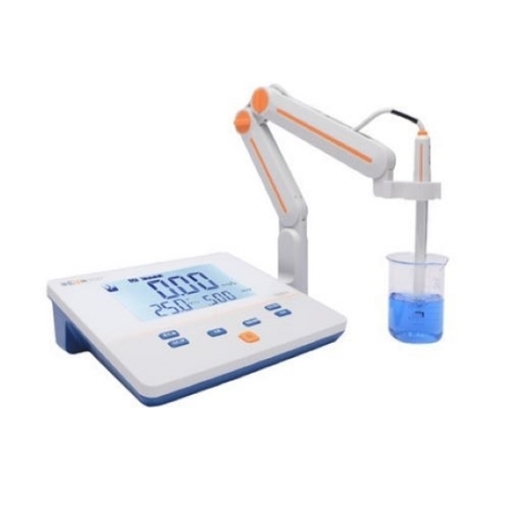
Electronic PH Conductivity Meter, DC9V, TDS Water Tester
Original price was: $761.38.$76.99Current price is: $76.99.
This electronic pH conductivity meter comes with a standard DJS-1VTC conductive electrode (platinum black) and offers IP54 dust and water resistance, making it suitable for use in various common environments. This desktop ec meter covers a measuring range of 0.00μS/cm to 200mS/cm, supports both manual and automatic temperature compensation, and runs on a DC 9V power supply with an accuracy of ±1.0%FS. Its ultra-high-definition LCD screen clearly displays conductivity constants and data stability indicators, while also providing continuous reading and balanced reading functions for flexible measurement needs. With wide applicability, this water tester can effectively test the conductivity and Total Dissolved Solids (TDS) of aqueous solutions.
Specification
| Model | T-DDS-307A |
| Shipping weight | About 0.9kg |
| Dimension | 242×195×68(mm) (L*W*H) |
| Standard electrode measurement range | 2μS/cm~200mS/cm |
| TDS | 1. Measuring rage: 0.00mg/L~100g/L 2. Electronic unit reference error: ±1.0% (FS) 3. Minimum resolution: 0.01mg/L (Optional according to range) |
| Standard electrode configuration | DJS-1VTC type conductive electrode (platinum black) |
| Temperature | 1. Rage: (-5.0~110.0)℃ 2. Minimum resolution: 0.1℃ 3. Electronic unit element value erro: ±0.2℃ |
| Measurement accuracy | Conductivity |
| Conductivity | 1. Measuring range: 0.00μS/cm~200mS/cm 2. Minimum resolution: 0.01μS/cm (Optional according to range) 3. Electronic unit repeatability: 0.33% (FS) 4. Electronic unit reference error: ±1.0% (FS) |
| Operation keys | ON/OFF, CAL, MODE, UP & DOWN, STORE/RECALL, ENTER |
| Product components | LCD display screen, function selection button, power switch key, electrode bracket, conductive electrode |
| Power supply | Power adapter (input: AC100~240V, output: DC9V) |
| Working temperature | (-5.0~110.0)℃ |
| Conductivity level | Level 1.0 |
Features
- Convenient and Accurate Reading: Equipped with a high-definition LCD display and button operation. It shows conductivity constants and data stability indicators.
- Multiple Modes: Supports equilibrium measurement mode and continuous measurement mode. It can automatically identify conductivity standard solutions, supports 1-point calibration, as well as automatic and manual temperature compensation.
- Multiple Options for Wide Applications: Supports temperature and custom standard solution settings. It also allows the setting of electrode constants.
- Data Storage and Instrument Protection: Supports data storage (50 sets), deletion, and review. It has a power-off protection function and supports restoring factory settings.
Details
4 Tips to Improve the Accuracy of TDS Conductivity Meter
- Standardize the use and maintenance of electrodes: Install them correctly and ensure a secure connection between the electrodes and the instrument. During measurement, make sure the electrodes are in full contact with the solution. Calibrate the electrodes at regular intervals according to the frequency of use, and correct parameters such as the electrode constant. Immediately after measurement, rinse the electrodes with deionized water to remove any adhering solution, preventing electrode contamination or corrosion caused by residual solution.
- Optimize the measurement environment: Conduct measurements in an environment with a constant temperature as much as possible. Keep the conductivity meter away from strong electromagnetic interference sources such as large motors and transformers, and use shielded wires to connect the electrodes to the instrument to reduce the impact of electromagnetic interference on the measurement signal.
- Select the measurement solution appropriately: Ensure that the collected solution sample can represent the overall characteristics of the solution to be measured, and avoid collecting uneven parts containing impurities, precipitates. Wait until the solution is fully dissolved, mixed evenly, and the temperature is stable before measuring.
- Standardize instrument operation: After turning on the instrument, preheat it for a sufficient time as required by the instrument manual to allow the internal circuits and sensors of the instrument to reach a stable working state, reducing measurement errors caused by unstable instrument startup. Strictly follow the steps specified in the instrument operation manual for measurement, including the transfer of the solution and the selection of measurement time.