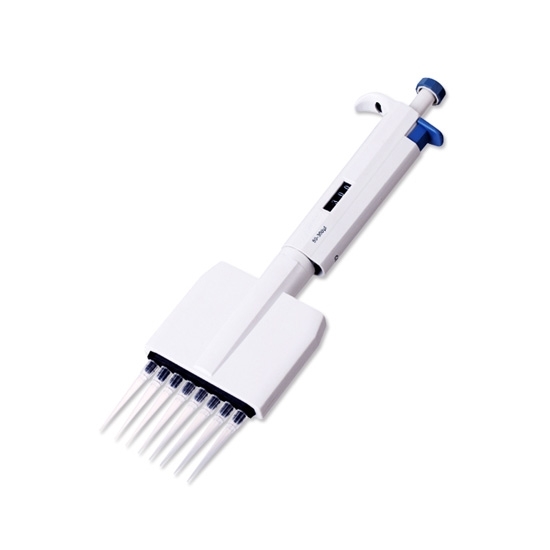
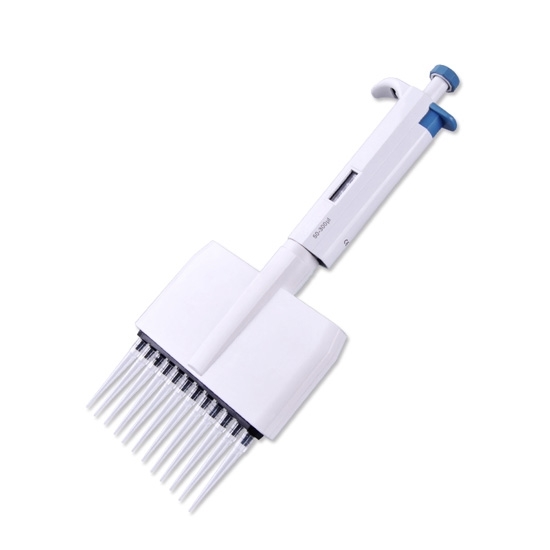
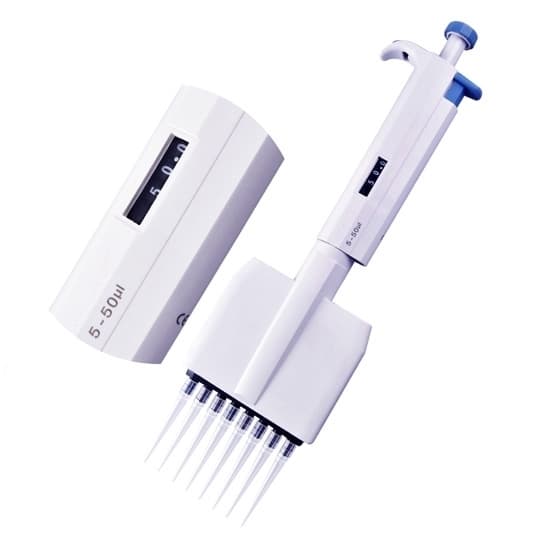
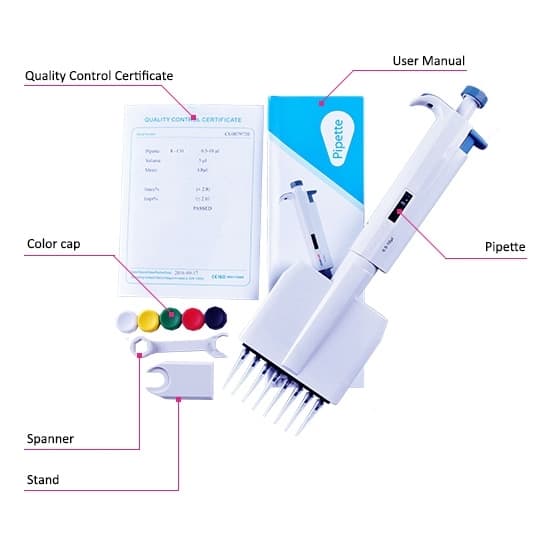
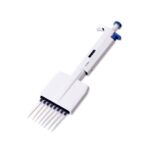
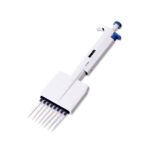
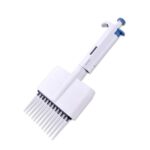
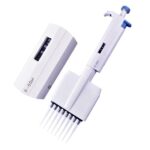
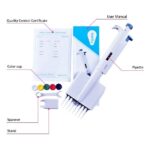
Adjustable Volume Multichannel Micropipette, 0.5-10µl/5-50µl/50-300µl, 8/12 Channel
Price range: $77.99 through $114.82
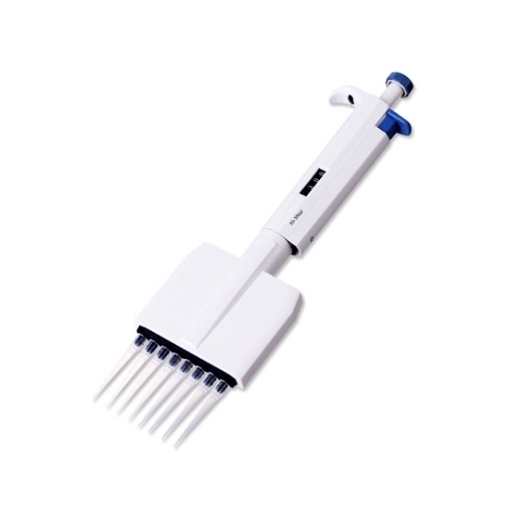
The multichannel micropipette (8/12 Channels, 0.5-10µl/5-50µl/50-300µl) is designed for efficient, high-precision liquid handling. Its ergonomic design, low plunger pressure, and easy tip change system make it ideal for repetitive tasks, ensuring comfort and accuracy. With a clear volume display and lightweight construction, it is perfect for daily use in labs that require fast, reliable results.
Features
- Multichannel micro pipettes are offered in volumes of 0.5-10μL, 5-50μL or 50-300μL
- 8-channel and 12-channel pipettes are suitable for standard 96-well plate
- 360 degree rotating dispensing head offers optimal pipetting convenience
- 3-digit volume display for clear reading and easy volume setting
- Mechanical pipettes with ergonomic handle design, light, easy and smooth operation
- Tips ejector allows 8-channel and 12-channel on-hand operation, easy and fast
- The lower section can be autoclaved at 121℃.
- CE certification
Specification
| Model | Volume Range | Increment | Testing Volume | Maximum Allowable Error (Systematic) | Maximum Allowable Error (Random) | ||
| % | μL | % | μL | ||||
| T-M8-10 | 0.5-10μL (8 Channel) |
0.1μL | 10μL | 1.50% | 0.15 | 1.50% | 0.15 |
| 5μL | 2.50% | 0.125 | 2.50% | 0.125 | |||
| 1μL | 4.00% | 0.04 | 4.00% | 0.04 | |||
| T-M8-50 | 5-50μL (8 Channel) |
0.5μL | 50μL | 1.00% | 0.5 | 0.50% | 0.25 |
| 25μL | 1.50% | 0.375 | 1.00% | 0.25 | |||
| 5μL | 3.00% | 0.15 | 2.00% | 0.1 | |||
| T-M8-300 | 50-300μL (8 Channel) |
5μL | 300μL | 0.7% | 2.1 | 0.25% | 0.75 |
| 150μL | 1.00% | 1.5 | 0.50% | 0.75 | |||
| 50μL | 1.50% | 0.75 | 0.80% | 0.4 | |||
| T-M12-10 | 0.5-10μL (12 Channel) |
0.1μL | 10μL | 1.50% | 0.15 | 1.50% | 0.15 |
| 5μL | 2.50% | 0.125 | 2.50% | 0.125 | |||
| 1μL | 4.00% | 0.04 | 4.00% | 0.04 | |||
| T-M12-50 | 5-50μL (12 Channel) |
0.5μL | 50μL | 1.00% | 0.5 | 0.50% | 0.25 |
| 25μL | 1.50% | 0.375 | 1.00% | 0.25 | |||
| 5μL | 3.00% | 0.15 | 2.00% | 0.1 | |||
| T-M12-300 | 50-300μL (12 Channel) |
5μL | 300μL | 0.70% | 2.1 | 0.25% | 0.75 |
| 150μL | 1.00% | 1.5 | 0.50% | 0.75 | |||
| 50μL | 1.50% | 0.75 | 0.80% | 0.4 | |||
Multichannel Micropipette Details
Tips: The classification of Pipettes
Pipettes are essential tools in laboratories for precise measurement and transfer of liquids. They come in various types, each suited for specific tasks depending on the volume of liquid, the level of precision required, and the method of operation. Here’s an overview of pipette classification:
- By Volume Range
Pipettes are classified based on their volume capacity. Micropipettes are typically used for small volumes ranging from 0.1 µL to 1000 µL (1 mL), ideal for precise liquid transfer in molecular biology and biochemistry. Macropipettes handle larger volumes, typically above 1 mL, and are used for bigger sample sizes. Graduated Pipettes (1 mL to 50 mL) are commonly used for measuring and transferring intermediate volumes. - By Mechanism of Operation
Pipettes can also be classified based on their operation mechanism into air displacement pipettes and positive displacement pipettes. Air displacement pipettes use air pressure to aspirate and dispense liquids, and they are the most commonly used. They come in manual and electronic versions, with the electronic type offering better precision and reducing operator fatigue. Positive displacement pipettes, where the piston directly contacts the liquid, are used for handling viscous or volatile liquids. - By Precision and Number of Channels
Pipettes can be single-channel or multi-channel. Single-channel pipettes are used for transferring one sample at a time, making them versatile for various general laboratory tasks. Multi-channel pipettes allow simultaneous dispensing into multiple wells (e.g., 8, 12, or 96), making them ideal for high-throughput applications such as PCR, ELISA, or microplate assays. - By Adjustability
Pipettes can also be categorized based on their adjustability into fixed-volume and variable-volume pipettes. Fixed-volume pipettes are designed to transfer a specific, unchangeable volume of liquid, typically used for repetitive tasks. Variable-volume pipettes offer flexibility, allowing users to adjust the volume according to their needs, which is useful for experiments requiring different liquid volumes. - By Material
Pipettes come in two primary materials: glass and plastic. Glass pipettes are known for their accuracy, reusability, and ease of cleaning, but they are fragile. Plastic pipettes are more common for single-use, less expensive, and more durable but might not provide the same level of precision as glass pipettes in certain high-accuracy applications. - By Application
Pipettes are also classified based on their specific applications. Serological pipettes are typically graduated and are used in microbiology, cell culture, and other precise liquid handling tasks. Pasteur pipettes, which are usually simple and ungraduated, are used for transferring small amounts of liquid in routine laboratory work.
Selecting the right pipette type is crucial to ensure accuracy, efficiency, and the best results for any specific experiment.
| Volume Range * | , , , , , |
|---|